Royal Academy of Arts in the Age of Giorgione
Much is made of the mystery surrounding Giorgione, a painter of pivotal influence, well-nigh whom, paradoxically, we know almost nothing beyond the manner of his expiry. He died in a Venetian plague colony in 1510 aged well-nigh 33, and was as elusive in the 16th century equally he is today, his paintings highly sought afterwards just hard to come up by, and past the time of his expiry already invested with mythic status.
Today, there are nigh xl paintings attributed to Giorgione, and of those, only a handful are secure in their attribution: this is an exhibition nearly an creative person who exists as a ghostly trace in paintings past the stars of the Venetian firmament.
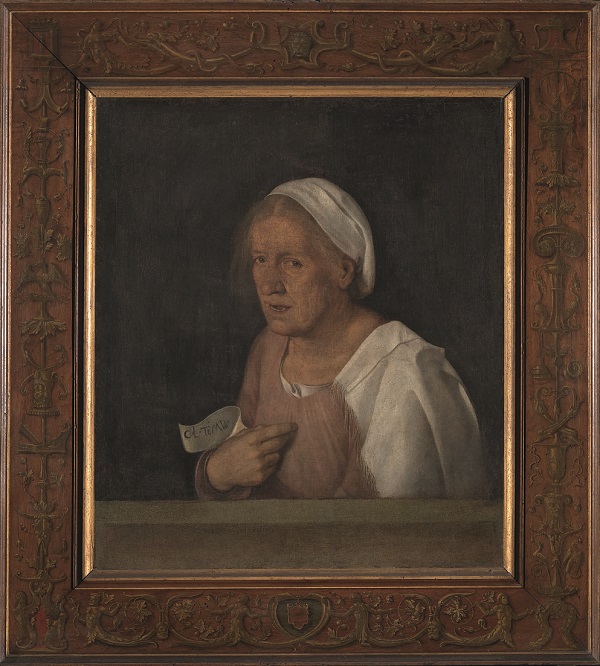
So little is known of Giorgione'due south biography, and notwithstanding he was such a huge influence on the next generation of Venetian artists – notably Titian – that his piece of work has oftentimes been indistinguishable from that of the circumvolve of artists who would go synonymous with the achievements of 16thursday-century Venice. The exhibition claims to address the topic of attribution that inevitably arises, but glosses over the serious uncertainty attached to paintings billed non but as "attributed to" merely "past" Giorgione. One of the stars of the testify, La Vecchia (pictured below right), is oft said to depict Giorgione'south elderly mother, simply the message in her paw, "Col Tempo" (With Fourth dimension), and the urgency with which she seeks our gaze makes it principally allegorical, a warning that age comes to u.s. all. Information technology is labelled every bit if Giorgione'due south authorship is unequivocal, and you lot would need to read the catalogue to observe the painting's contested condition.
 Similarly the Terris Portrait, thought to date from 1506, is an uncannily immediate painting that subjects the viewer to the intense gaze of a now anonymous human being. Said to be by Giorgione, it has a provenance that goes back only as far as the 19th century, with certainty near its authorship resting in large part on a gimmicky inscription on the dorsum of the panel that names Giorgione as its maker.
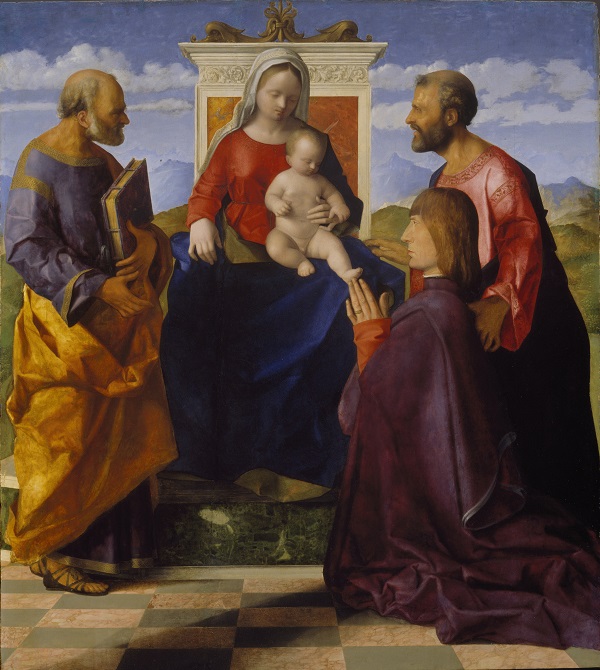
Nevertheless, the portrait gains authority considering it seems infrequent, embodying some of the influences and innovations that must take made Venice a truly remarkable identify at the turn of the 16th century. Giovanni Bellini, the godfather of Venetian painting was still alive, and the incredibly well-travelled Dürer was hither in 1506, his fondness for mural chiming with a new regard for mural in Venetian painting (pictured below left: Giovanni Bellini, Virgin and Kid with Saint Peter, Saint Mark and a Donor, 1505). Leonardo da Vinci had visited in 1499, his feature sfumato technique apparently catching on and seen hither in the Terris Portrait contributing to the painting'south vitality and naturalism.
Giorgione is presented in the broadest of brushstrokes, absorbing and reinterpreting influences and bringing to portraiture and devotional imagery a drama and immediacy that would come to be a defining characteristic of Venetian painting (main picture: Titian, Christ and the Adulteress, c.1511). In keeping with his enigmatic persona, he is presented as an influence more than an actual presence, and the exhibition's pleasingly simple, essentially linear interpretation shows a curiously old-fashioned arroyo to art history. Ironically, it is the paintings said to be by Giorgione himself that threaten to disrupt an otherwise corking and tidy narrative, and the astonishing variance in the physical condition of these paintings means that to treat them as works by the same paw is, at times, something of a bound of faith.
 I notable juxtaposition is of the enigmatic Portrait of an Archer, and the Portrait of a Young Homo and His Servant (both undated). Both are attributed to Giorgione and yet the comparing is bewildering, the poor but surely authentically 16th-century condition of the archer jarring with the brilliant, make clean colours of the other, a painting that has obviously been cleaned, perhaps rather enthusiastically, in the non so distant past.
Paintings are all inevitably in variable states of repair; condition is dependent on many factors, from artists' technique to the frequently complicated life stories that have ensured their survival for, in Giorgione's case, some 500 years, not to mention the conservation policies of the institutions that now care for them. What is beyond dispute is that in the instance of Giorgione, many of the works attributed to him are difficult to reconcile with one some other. Whether this is due to different conservation histories or, ultimately, unlike authors is a question that can just exacerbate the difficulties faced by scholars trying to plant a secure oeuvre for Giorgione. On this note, the late arrival of the Iii Ages of Human, c.1500, due at the end of March following conservation treatment, should be anticipated with equal measures of excitement and trepidation.
- In the Age of Giorgione at the Royal Academy until 5 June
@FlorenceHallett
Source: https://theartsdesk.com/visual-arts/age-giorgione-royal-academy
0 Response to "Royal Academy of Arts in the Age of Giorgione"
Post a Comment